
A Gesture from the Next Desk
Wait near a source of information
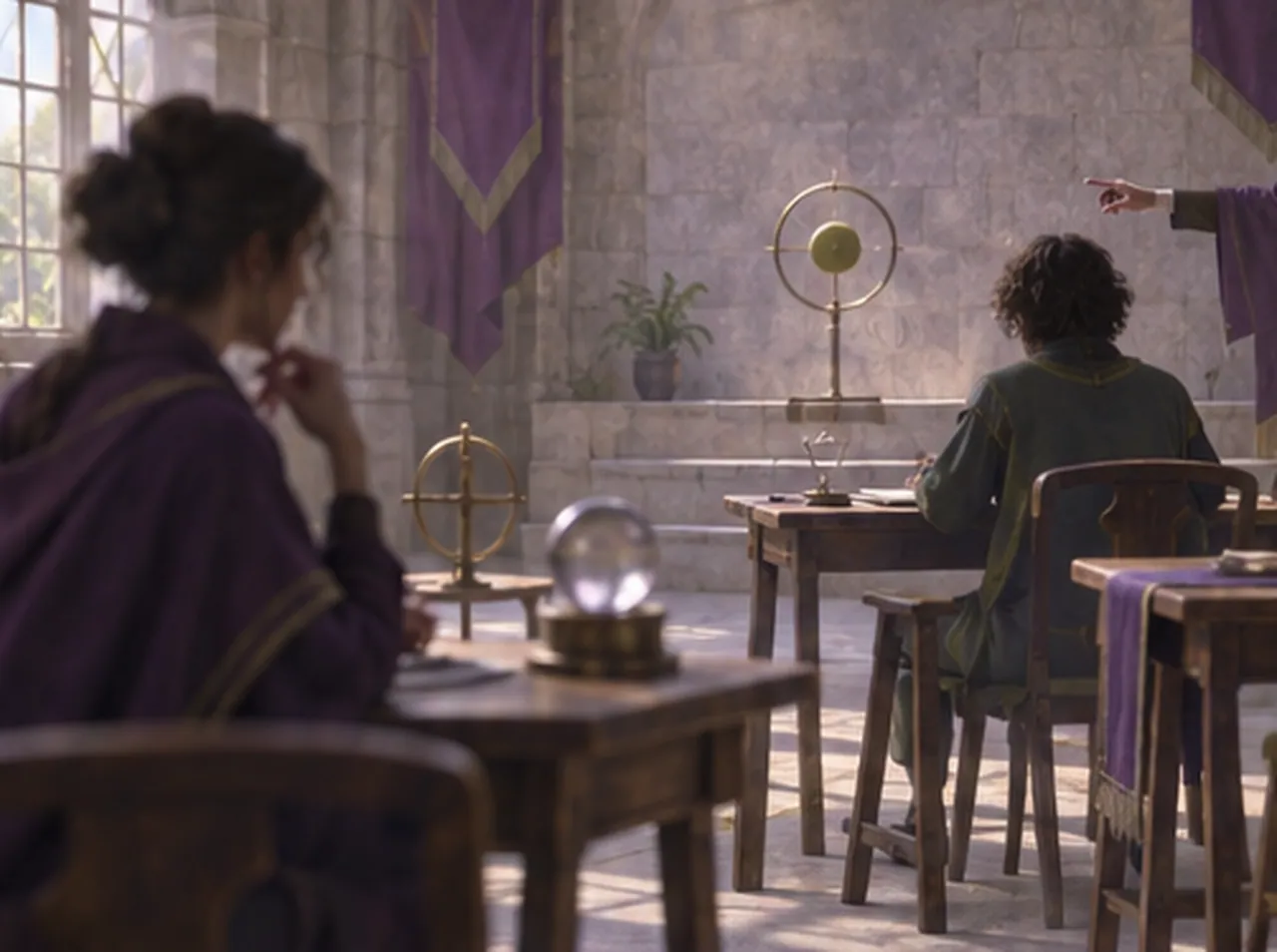
When a light slips past a desk, there are several places a player could look. The teacher sees an apprentice’s tray and the shade of a slate from a different angle. We considered letting the teacher step into a clear position and ask the student to put a practice tool into its rest. That offer risks explaining the solution at exactly the moment when a player could discover how seating affects the next view. A small gesture can draw attention to the availability of a viewpoint without saying what the apprentice will see from there.
The gesture in this trial takes place between the near desk and a second slate. The teacher turns slightly and leaves a hand above an open part of the table. The player can infer that walking around the desk is possible. A student who was watching the bright tail might now decide to move or to stay and try to see what happens from the first seat. Both are still available. In The Spell in the Wrong Seat, some movements create a delayed turn, so seeing more of the last motion is valuable before reaching for the next.
Check the body and the destination separately
A pointing figure can be recognized even when a player only catches a brief glimpse. We first draw a hand with a low broad motion toward a free place. The cloth at the wrist is simple against the table. From the side of the adjacent slate, a straight arm crosses a dark band behind the teacher. Its direction looks more definite than we meant. If we mark a place on the desk before indicating a small motion, the apprentice can see the place after the arm has moved away.
We can make the desk itself help. One edge has a clear path around it, and a short line along the floor shows where a tray can be set down without blocking the route. A gesture toward that edge catches the eye. The visible path provides the information that makes the gesture useful. If a player keeps watching the floor in the later part of the scene, the teacher need not repeat the same motion.
Offer help without moving an object for the learner
An opening could let the teacher move the stray light on the player’s behalf. That would give a clear demonstration at the cost of obscuring the student’s previous choice. Another option keeps the teacher out of reach of the tool. They can ask whether a long desk hides anything the apprentice wanted to see, show a place to stand, or wait. Using the quiet response can make sense after the student has already begun comparing views. A first trial compares the gesture on its own with the gesture and a one line question.
Keep the change available at a second visit
A dialogue line can go by too quickly for someone reading signs in the room. If the apprentice comes back from the other direction, a strip of open floor is still connected to the edge of the same desk. It gives the player something they can find again without making the teacher perform the scene a second time. We can let the cue appear from a slightly different side in another lesson and then ask a player to point to the area where it was possible to move.
The Chalk Mark on a Retry takes a similar concern into a separate trial. The saved mark gives the student a point that remains while time returns to an earlier moment. The gesture uses a room feature that remains after a person leaves. The design review can compare how each detail looks just before and just after the apprentice chooses to cross the room. This helps show how much of the cue lives in the gesture and how much the place itself already communicates.